How Does a Chemical Export Company in the Netherlands Support Global Chemical Supply Chains?
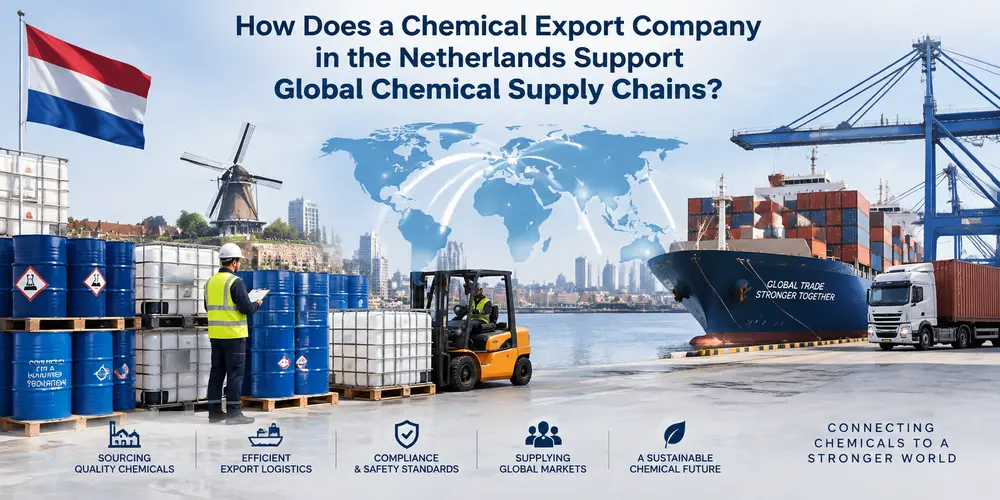
The global chemical industry runs on this strange mix of precision, timing and trust. Like, one little disruption in raw material availability can spread effects across manufacturing lines in dozens of countries within days, and nobody really gets to “wait and see.” That is exactly why a reliable Chemical Export Company suddenly becomes such a big deal in today’s tangled economy. If you place the company at the crossroads of Europe’s biggest ports and industrial hubs, then a Chemical Export Company in the Netherlands doesn’t just help, it kind of keeps the whole supply chain machine moving, smoothly.
The Netherlands: A Natural Hub for Chemical Trade
It’s not really an accident that so many exporters operate out of this small European nation. The Netherlands gives you port infrastructure that is hard to match, especially the Port of Rotterdam, which is also one of the busiest and most technologically advanced ports in the world. Add on top that strong road, rail, and inland waterway connections, and the country becomes a natural launchpad for chemical shipments heading toward Asia, Africa, the Americas, or even the rest of Europe. Also, a chemical company in the Netherlands benefits from a mature regulatory environment too. Dutch authorities, and the broader European Union, keep strict but well-defined standards for chemical safety, packaging, and transport. That clarity doesn’t feel like a burden in practice, it becomes a competitive edge. International buyers know that chemicals sourced from the Netherlands generally hit consistent quality and compliance benchmarks, which reduces the chance of customs delays or safety problems later.
Sourcing and Supplier Networks
One of the most valuable parts of exporting is supplier aggregation. Instead of a buyer negotiating alone with dozens of manufacturers located across different countries, Chemical Suppliers Netherlands pulls those sourcing relationships into a single streamlined channel. That means buyers can reach a wide catalog of industrial, agricultural, and specialty chemicals through one point of contact, which saves time, reduces paperwork chaos, and often helps secure better pricing thanks to bulk procurement arrangements. This approach also makes them a reliable Chemical Products Supplier for Global Industries, offering access to diverse chemical solutions through established supplier networks. These supplier networks usually cover multiple chemical categories: solvents, acids, alkalis, surfactants, resins, and specialty additives. Because Chemical Suppliers Netherlands work with a diverse base of producers, they can pivot fairly quickly when one supplier hits a shortage. So continuity of supply stays steadier, even during volatile market periods, which became extra obvious after the supply chain shocks of recent years.
Logistics, Compliance, and Risk Management
Exporting chemicals is not “just ship it” like other commodities. A lot of chemical products get classified as hazardous materials, so they need specialized packaging, labeling, and documentation. International frameworks like IMDG (International Maritime Dangerous Goods) and ADR (road transport) are often involved. A capable exporter manages these requirements for the buyer, including UN-approved packaging, safety data sheets, REACH compliance documentation, and accurate customs declarations. This is where the real value shows up. Handling those regulatory layers needs real technical knowledge, established relationships with certified freight forwarders, and a proven history of clean customs clearance. Buyers who partner with an experienced exporter tend to avoid expensive issues like misclassification, incomplete paperwork, or the kind of non-compliant packaging mishap that can result in shipment seizures or hefty fines.
Supporting Specialized Industries
Global supply chains aren’t only about generic bulk chemicals either. A lot of sectors need highly specific formulations and, honestly, consistency is what keeps everything from wobbling. In the paints and coatings industry for example, producers depend on stable, high-purity feedstocks so every batch ends up behaving the same way. A reliable Coating Chemical Supplier for Paints and Adhesives does more than “just deliver” because it helps make sure resins, binders, pigments, and additives line up with the exact specification sheets, every single time, even when the schedule feels hectic. And this matters a lot in real life situations where tiny variations can mess with durability, the final appearance, or the adhesion strength. In a similar way, the Agriculture Industry in Netherlands depends heavily on chemical exporters for fertilizers, crop protection agents, and soil treatment compounds. Even though the Netherlands is relatively small, it’s among the world’s largest agricultural exporters, and that outcome is closely tied to access to higher-quality agrochemicals. Exporters serving this sector need to understand seasonal demand cycles, regional crop needs, and changing environmental regulations around pesticide and fertilizer use. That knowledge supports international farming operations that are sourcing those inputs in the first place.
Building Long-Term Supply Chain Resilience
Most modern buyers do not only want one transaction. They want a dependable long-term partner, and that’s usually where the better Chemical Export Company approach comes in. A well-established exporter typically offers services beyond basic order fulfilment like inventory planning support, market intelligence on price trends, and flexible shipment scheduling that lines up with a buyer’s production calendar. This partnership style really pays off during periods of geopolitical uncertainty, or raw material scarcity. Exporters with diversified sourcing and warehousing capabilities can act like a buffer, helping client companies avoid production stoppages even when a specific region faces supply disruptions. Many exporters also keep warehousing facilities near major Dutch ports, so the turnaround gets faster and the lead time between order confirmation and delivery shortens.
Sustainability and the Future of Chemical Trade
Sustainability is slowly but surely shaping how chemicals are sourced and transported, like buyers are asking even tougher questions about carbon footprint, packaging waste, and what kind of environmental routines suppliers actually use. In the Netherlands a chemical business that’s looking ahead is starting to push greener packaging options, fine tune shipping routes to lower emissions, and improve its Technical Industry Services by putting more attention on suppliers who manufacture in a responsible manner. It’s not only about ticking compliance boxes, it’s becoming a real edge, in a sector where the end customer increasingly cares about sustainability credentials, of the product they end up buying.
Get in touch with best Chemical Export Company in Netherlands
When it comes to international rules that feel confusing, and the work of connecting buyers with a reliable Chemical Export Company in Netherlands, Dutch exporters do way more than simple logistics. They operate like strategic teammates, absorbing a lot of the complexity so manufacturers in coatings, agriculture, or industrial manufacturing can stay focused on their own operations, without stressing about supply hiccups or disruptions. For companies that want a dependable and experienced partner here, Company name: vandiemenchemicals.com brings the kind of sourcing know-how, compliance understanding, and logistical backing that modern global supply chains expect.
Frequently Asked Questions
1. What does a chemical export company actually do, like in real life?
It gets chemicals from manufacturers, deals with packaging (and the annoying regulatory stuff too), arranges international shipping, then delivers the products to buyers all over the world.
2. Why is the Netherlands seen as a big hub for chemical exports?
It basically has world-class ports, dependable logistics infrastructure, and a clear EU rules setup, which together makes the whole chemical trade pretty efficient compared to a lot of other places.
3. What chemicals are usually shipped out from the Netherlands?
You often notice industrial solvents, acids, resins, coating components, agricultural chemicals, and specialty additives getting exported, sometimes in bulk, sometimes in smaller batches.
4. How do exporters keep shipments inside safety rules?
They manage UN-approved packaging, hazard labeling, safety data sheets, and the paperwork that has to match things like IMDG and ADR.
5. Can a chemical exporter help find raw materials that are hard to source?
Yes, many well established exporters have wide supplier networks, so if a preferred vendor runs out or slows down, an alternative chemical supply route can be found fast.
6. How does the agriculture sector benefit from Dutch chemical exporters?
They give farmers and agribusinesses steady access to quality checked fertilizers and crop protection solutions, which helps keep crop results more reliable.
7. Are chemical exports from the Netherlands always more expensive than buying straight from manufacturers?
Not always. With consolidated sourcing, bulk purchasing strength, and smooth logistics, an exporter’s pricing can be really competitive, and it can also cut down extra costs caused by compliance errors or transport delays.
8. What should buyers pay attention to when picking a chemical export partner?
Look for regulatory know-how, supplier variety, clean documentation processes, and a track record for on time deliveries that remain compliant even when conditions change around them.