What Technologies Are Driving Efficiency in the Food Processing Industry in Netherlands?
The Netherlands has, for a long time, kept a solid reputation as one of the most advanced food-producing places on Earth, even if the country itself is pretty small on the map. From dairy and candy type goods, to bread products and processed proteins, the food processing industry in Netherlands has built this big name by focusing on innovation, tight control, and sustainability. In this piece, we look at the main technologies that help Dutch food processing work faster and cleaner, and also why the Netherlands keeps getting treated like a reference point by the global food industry.
A Legacy of Innovation in Dutch Food Manufacturing
The Netherlands ships out agricultural and food items per person more than almost anywhere else, and that doesn’t happen by luck. It is the result of decades of investment in research, automation, and sustainable methods. Food industry companies Netherlands have been pushing efficiency for years, not only to stay competitive, but to follow strict European Union rules around food safety, emissions, and traceability. That habit of constant upgrades has made it easier to adopt newer tech some countries are only starting to think about it now, while the Dutch already moved ahead
1. Automation and Robotics on the Processing Line
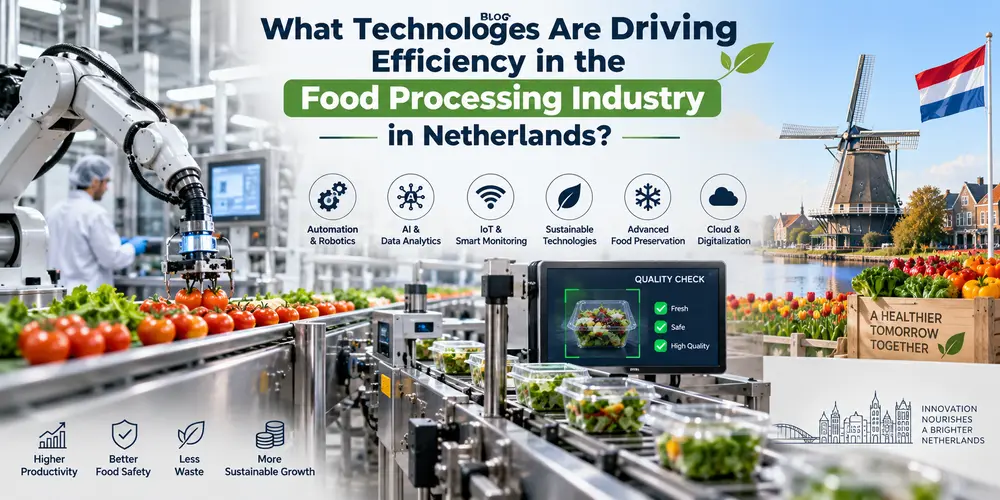
A thing you can clearly see in Dutch facilities is how much robotic automation is now part of everyday work. Robot arms handle repeat steps like sorting, packing, palletizing, and quality checks, with speed and steadiness that manual labor just cannot keep up with. The upside is less contamination, lower product loss, and workers can spend more time on tasks that actually need human judgment, like fine tuning processes and verifying quality. Many mid-sized as well as bigger food industry companies Netherlands now use collaborative robots, or cobots, that support the staff instead of forcing a full plant reset.
2. Artificial Intelligence and Predictive Analytics
AI systems are also showing up in practical roles: they help predict failures before they happen, cut down on ingredient waste, and improve demand forecasting. Predictive maintenance software reads sensor signals from machines as they run, then warns operators about possible breakdowns days, or even weeks, earlier. This “stay ahead” mode really lowers the risk of unplanned downtime, which can hit hard in steady-flow settings like dairy pasteurization or meat processing lines
AI is also used to adjust recipes and formulations, making sure products stay consistent while using fewer raw materials during each production run. And yeah, this is part of why the reputation stays strong. Along with all these advances, certain supporting materials still matter too, like having a reliable Coating Chemical Supplier for Paints and Adhesives, because coatings and adhesive mixes quietly help keep packaging equipment and plant systems protected and working reliably.
3. Internet of Things (IoT) and Smart Sensors
Inside Dutch processing sites, IoT sensors are now placed everywhere, checking conditions like temperature, humidity, machine vibration, and even energy draw. With this constant flow of information, managers can make adjustments right away, so products stay inside safe ranges while energy use doesn’t jump unnecessarily. Smart sensors also help with traceability, which is increasingly demanded by regulators, and by customers who want to know where their food came from, and how it was managed along the way.
4. Advanced Cold Chain and Packaging Technology
Because the Netherlands is a big exporter of perishable goods, cold chain upgrades have kind of become a must. Better refrigeration methods can use less energy, but still keep temperature regulated more precisely, so shelf life tends to stretch out and spoilage drops. At the same time packaging isn’t staying still either: barrier films, vacuum sealing, and modified atmosphere packaging, MAP, all combine to preserve freshness while shipments move out to international markets. Food grade chemicals manufacturers also play an important role in supporting the safety and performance of materials used across these food-related processes. Worth noting, the equipment and infrastructure on these packaging routes sometimes rely on specialized coatings to fight corrosion, chemical contact, and constant wear. That’s where a trusted coating chemical supplier for paints and adhesives becomes extra useful, because the right protective coatings and adhesive formulations help processing equipment, storage tanks, and packaging machinery last longer under tough industrial stress.
5. Sustainable and Circular Processing Technologies
Sustainability is not treated like a side topic in Dutch food manufacturing; it is basically part of the design itself. Technologies that turn food processing leftovers into animal feed, biogas, or fertilizer are common now, which helps reduce landfill waste and may even create extra income. Water recycling systems, energy-saving drying methods, and even solar-backed processing units are also becoming normal across the sector, tied closely to the Netherlands wider climate targets. This circular strategy connects back to the Agriculture Industry in Netherlands, because that system provides much of the raw material for food processing, while also gaining value from processed byproducts that later return as fertilizer or feed for animals.
6. Precision Chemical Formulations in Food Production
Beyond machinery and software, the whole deal with efficiency really depends on the inputs used during processing. High-purity Food Grade Chemicals and Food Grade Chemical Ingredients matter a lot for preservation, pH control, cleaning, and just keeping formulation steady. When people use substandard chemical inputs it can trigger product recalls, uneven product quality, or even regulatory non-compliance and honestly, those problems can hit efficiency much harder than any equipment malfunction. So yeah, that’s why reputable food grade chemicals manufacturers are treated like strategic partners, not just “hey we have boxes of stuff” suppliers. When a company delivers certified, traceable, and consistently pure ingredients processors can avoid expensive mistakes and keep the high benchmarks that Dutch food exports are basically known for worldwide.
Building A Sustainable Food Processing Industry In Netherlands
The Food Processing Industry In Netherlands gets efficiency gains from a mix of smart automation, predictive technologies, sustainable practices, and dependable access to high-quality chemical inputs. For businesses that need a dependable partner for food-grade plus industrial chemical needs, vandiemenchemicals.com offers a solid track record on quality, compliance, and reliability. It fits pretty well with the expectations across the Dutch food processing industry.
Frequently Asked Questions (FAQs)
1. What makes the Netherlands kinda a leader in food processing technology
The Netherlands blends strong agricultural output, advanced R&D infrastructure, and strict EU regulatory standards. This combo nudges constant innovation across automation, sustainability, and quality control, even when the market is noisy.
2. What are food grade chemicals used for in processing
Food grade chemicals get used for preservation, pH balancing, sanitation, and formulation consistency, basically to keep products safe, stable and compliant with food safety rules, no shortcuts.
3. How does automation improve efficiency in food plants?
Automation trims manual errors, speeds up repeat steps like sorting and packaging, and helps keep consistency. It can also lower labor costs and reduce contamination risk, which honestly is never a small thing.
4. Why is the agriculture industry so important for food processing in the Netherlands?
The agriculture industry in Netherlands supplies raw materials for processing, but it also benefits from processing byproducts. So, you end up with an efficient closed loop supply chain, less waste, more reuse, and everyone looks better on the reports.
5. What role do coatings play in food processing equipment?
Coatings, or coating chemicals, shield machinery, tanks, and packaging equipment from corrosion and wear. That extends equipment lifespan, and it reduces maintenance related downtime, simple really, until it isn’t.
6. How do predictive analytics reduce downtime in food manufacturing?
Predictive analytics watch sensor data in real time, and they can flag potential issues before a failure shows up. Then maintenance gets scheduled on purpose, not because something already broke and caused a stoppage.
7. Are Dutch food processing technologies environmentally friendly?
Yes, many technologies focus on sustainability. Think water recycling, energy efficient drying, and turning byproducts into biogas or fertilizer, that kind of loop.
8. How do I choose a reliable food grade chemicals manufacturer?
Start by checking for the right certifications, clear sourcing, steady quality control, and evidence of regulatory compliance in food grade chemical production. If the paperwork and processes are solid, the rest usually follows, at least most of the time.